How European Portfolio Companies Win in the US in 2026 and beyond..
By Graham Locklear, Founder & CEO, M Search
Before you hire your US leader, read this.
At M Search, a large part of our practice has become helping European and UK-based private equity-backed software companies expand into the U.S. market. We do this by helping them identify exceptional go-to-market leadership talent here in the States. And on a lot of these calls, we go in, and many times these companies are asking us, “We’re thinking about hiring a VP. Should we hire a VP of Sales? a Head of Sales? a GM? or a CRO? What’s the best profile to look at for this hire?”
Wrong questions, IMO.
The hire matters. But even a strong leader can fail when the setup around them was never built for the US market.
Say you hire the wrong one:It takes you 6-8 months just to confirm it isn’t working, then it takes another 3-5 months to replace them, and another 3-4 months to ramp the next person.And just like that, you’re 12-18 months behind plan.
And you don’t have the time to burn. The clock you’re racing is a lot longer than it used to be. PE holding periods at approximately seven years now, well beyond historical norms.
When a US build goes sideways, the cause is usually a handful of decisions made before the offer letter ever went out.
That’s what this issue is about.
Let’s get into it…

Why the stakes are higher now
Revenue growth drove 71% of value created in 2024 PE exits (Bain), up from 64% in 2023. The leverage and multiple expansion playbook is largely spent at this point, and Bain’s midyear math shows how much harder returns have gotten. A deal that once needed 5% EBITDA growth for a 2.5x return over five years now needs about 12%.
The US is the largest B2B software market in the world at $379B in 2025, and for a lot of portfolio companies, US expansion is the investment thesis. So when the build stalls, it reads at exit as failed execution.
Bain also warns that the middle of the holding period is where value creation most often gets lost. A US build that stalls in year two and gets partly unwound in year three is exactly that loss.
The same report says:
the premium on talent and disciplined execution has never been higher.
Leadership tenure makes it riskier.
Average VP Sales tenure has fallen from 26 months to 19, a bad first hire is a 12-18 month recovery problem.. and even a good one might not stay very long.
What you’re walking into:
The US is the biggest B2B software market in the world. It’s also the toughest one to crack.
Most reps still miss:43.6% of B2B reps hitting quota across 252 software companies, down slightly from 44.22% in Q1. Even in a decent quarter, more than half of US reps miss.
The mid-year picture got worse. Eight of ten sales roles saw quota attainment decline.
Rep hiring is cooling. US sales and RevOps postings fell 6.8%while total US postings rose 5.0%. The same analysis notes that the pullback is mostly in reps, and that leadership hires are lumpy. My read is that a cooler rep market does not make a proven US revenue leader any easier to find. At the executive level, US searches typically run 120+ days from search start to hire. (we are faster.. but still).
Ramp is slow and churn is high. Mid-market AEs take 4-6 months to ramp and enterprise AEs take 9-12.
The margin for error is thinner than most teams expect and most of the mistakes I see are self-inflicted, usually from running the US the way you run things back home.
Which brings us to the next section.
Myth vs. reality:
what Europeans assume vs. what the US does
When a US build goes sideways, it’s almost always a habit from home that got dropped into the US without anyone stopping to ask if it would work.
Here’s how the two sides compare.
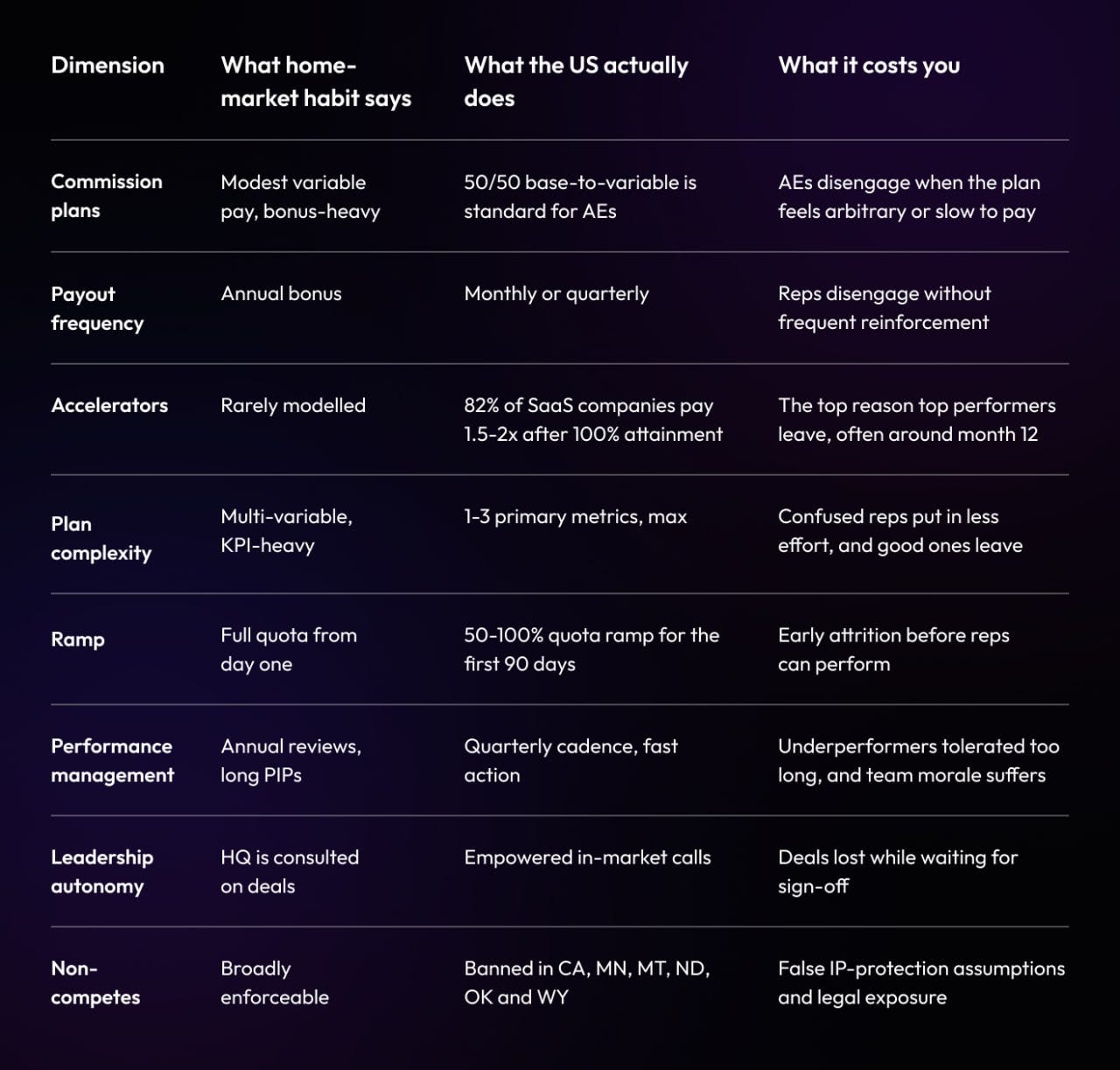
Most of it can get sorted out before the offer goes out, with a few hard conversations inside your exec team about comp, approvals and who actually has the authority to make a call in the US. That’s a lot cheaper than learning it from the US team.
If you’re pricing a US role right now, check out the playbook. It has comp benchmarks for 9 GTM roles, a 10-week search timeline, a must-have vs. false-positive scorecard and the 6 most common hiring failures
7 things to get right before the first offer
These are the seven things I’d want locked down before anyone signs
1) Price the role like a US employer.
Well for starters.. US comp is not home-market comp. The base is different, the split between base and commission is different, and the good candidates already know what the market pays.
If you benchmark against what you pay at home, you will lose your first-choice candidates in round one.
Do the research before the search starts. Get the real numbers for the role and the city, build them into the plan, and expect to pay more if you’re hiring in NYC or SF.
2) Build a pipeline before you build the team.
Good candidates want to join something that’s already moving.
It doesn’t need to be a machine. It needs to be real enough that what you say in the interview is true. Get the team you already have in front of US buyers, run some outbound, close a few deals if you can, etc.
That early signal tells you what kind of leader to hire, and gives you something honest to sell.
3) Decision rights in writing
Who can approve a price? discount? deal? and what has to go back to HQ? Most of the post-mortems I’ve seen trace back to remit and scope that never got spelled out.
Have that conversation before the offer goes out, and get into the details. Pricing authority, deal approval limits, escalation paths, all of it written down and agreed by everyone with a say.
4) Hire a plan
The instinct is to go with the person who tells the best story and work out the plan together once they’re in. But if you don’t know what good looks like before they start, you have nothing to hold them to.
Get your own team aligned on what good looks like first. Then make your finalists present a specific US game plan before you make an offer.
5) Stage fit over logo
You want the person who’s taken a US team from zero to something real, and for whom this move makes career sense right now. Have them walk you through what they built from scratch and who did the actual work.
6) Back-channel references
I understand why the listed references feel like enough.
But you also want to know how this person operates when things aren’t going well. That comes from the people who worked with them but didn’t get handed to you.
It takes a few extra calls and a bit of digging.
If you can’t find anyone, treat that as a warning but someone with a real track record in the US will have people who know their work.
7) A champion at HQ, and hire East Coast
US leaders fail on “the island.” They’re out there on their own, with nobody back home who has global context and enough authority to back them up.
The instinct is to name a sponsor and assume that covers it. A sponsor in name only doesn’t help when the leader needs a pricing call made on a random Tuesday.
Pick that person before the search starts. Make sure they have the time and the say, and put a regular check-in on the calendar so it doesn’t depend on goodwill.
And hire East Coast. It’s a small thing, but the overlap with the European workday is far better than the West Coast, and that overlap is where most of the real conversations with HQ happen.
Get these right and what’s left is picking the right person.

Red flag round: 5 things candidates say
- “I know this market.” ask them instead, “which buyers did you close in the last 12 months, and what changed?
- They demand enterprise-scale resources on day one. ask them, “what would you do with two AEs and one SDR?”
- They ask about title and comp before mission and market depth. the strong hires want to hear about the problem first.
- They only offer home-market success stories. ask them, show me a US win you personally led.”
- No references are available through shared contacts. an elite candidate should have networks that surface organic references.
If the answers stay vague when you push, believe the signal.. You want to find that out NOW.
Revenue Leader or General Manager?
Before you write the first job description, answer one question: what are you hiring for?
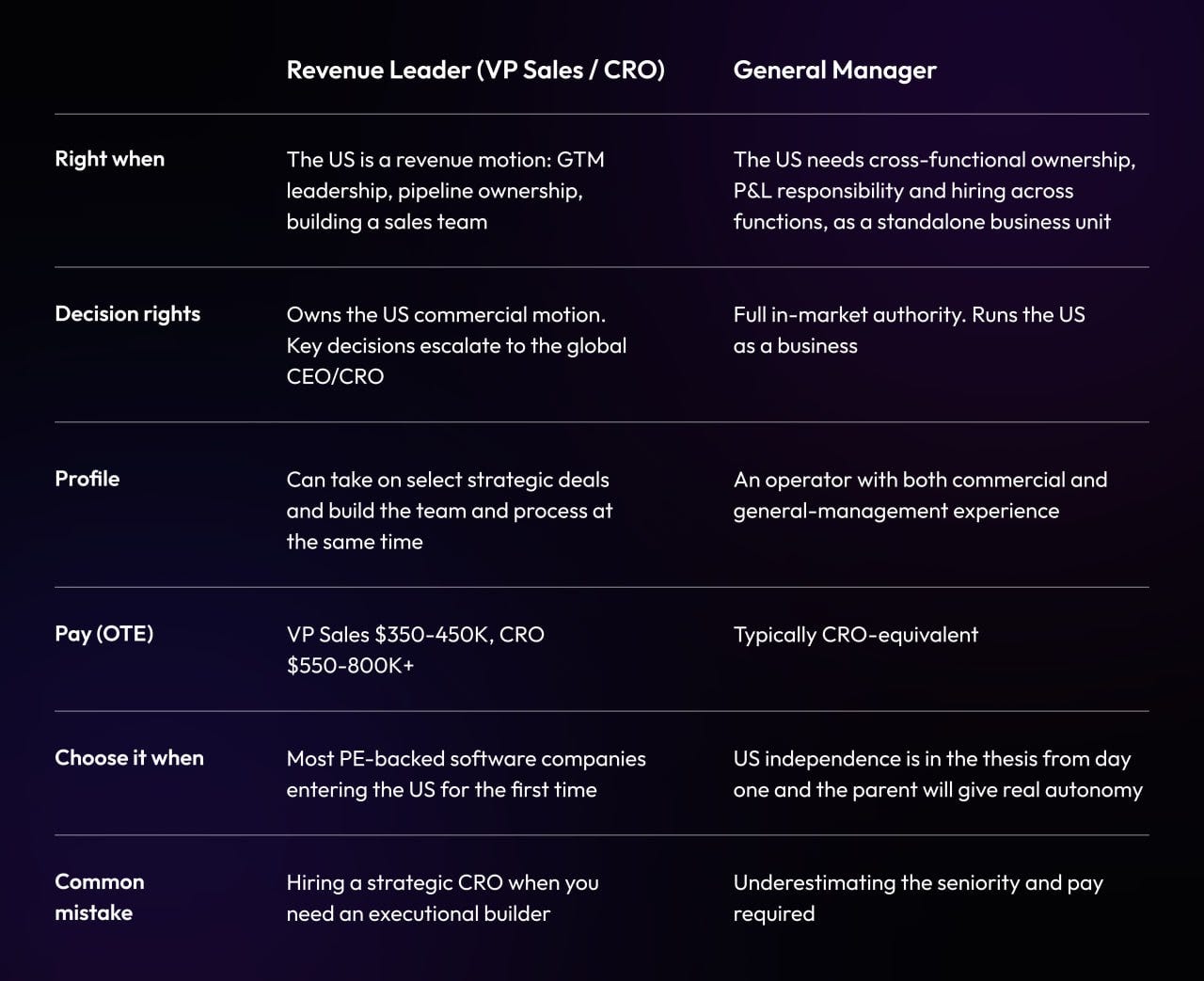
My verdict is that most PE-backed software companies entering the US should hire the Revenue Leader first
And a word of warning, a real GM is not a VP Sales with a bigger title.

Who to hire next
Segment matters before sequence. If you run one hiring profile across enterprise and mid-market, you’ll get systematic underperformance.
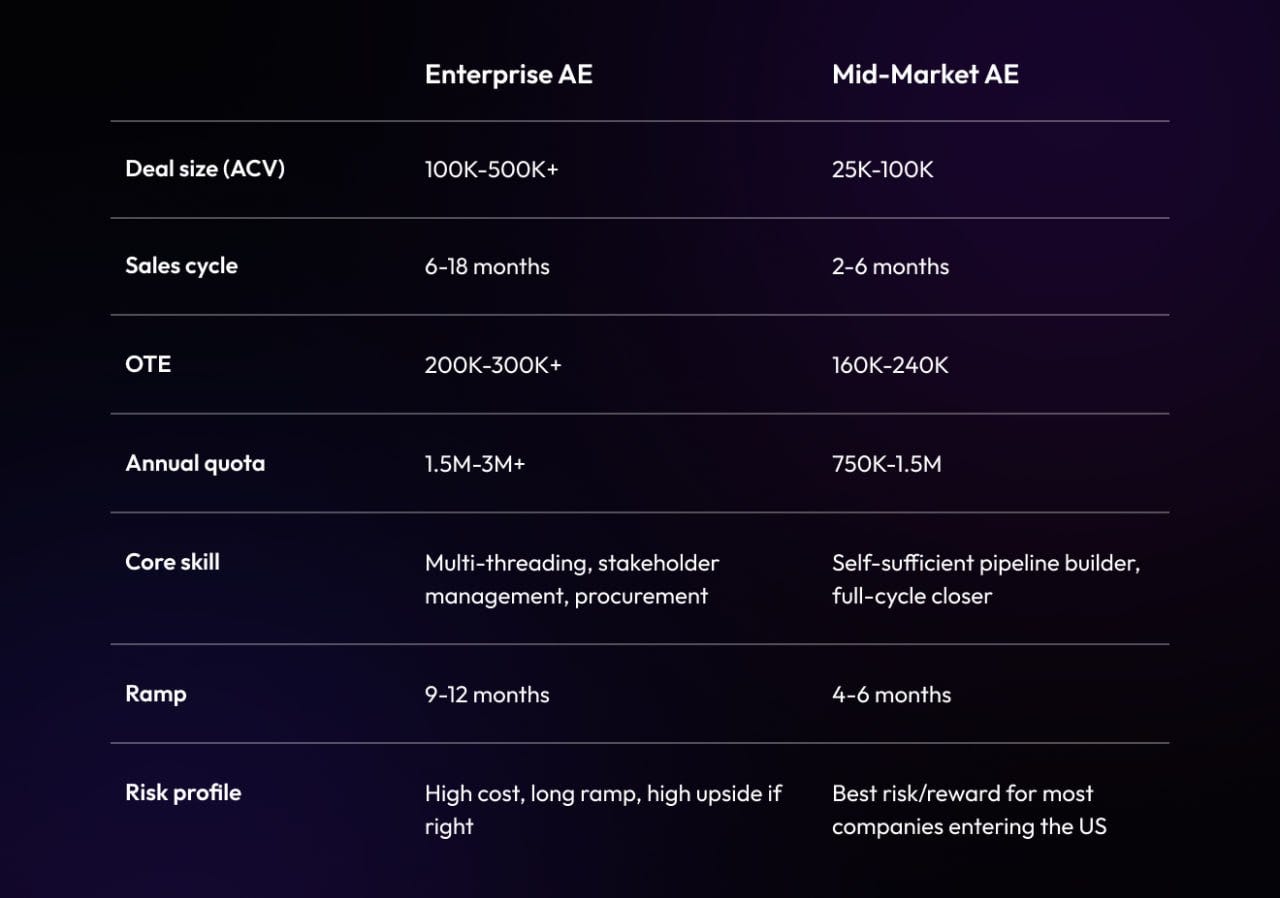
The sequence I’d follow:
- Mid-market AEs first. They’re full-cycle closers with a shorter ramp and a more manageable cost structure.
- SDRs at 1 per 1-2 AEs. That’s a reasonable starting ratio for business development.
- US marketing. Translating a value proposition from London or Amsterdam to a US buyer takes someone who really understands the local market.
- Customer success, earlier than feels necessary. If you doubled your US customers over the next two quarters, could you serve them without churn?
Most early US builds don’t need the full team on day one.. they need the right first few seats, in the right order, built for the segment you’re selling into
Bottom line
I’ve placed enough execs into US expansions to know this:
The talent is rarely the problem, the setup around the talent is.
If you want to crack the U.S. market, you need to treat the first leadership hire in the U.S. as a structural decision].. slow down for a second at the start so you don’t have to rebuild in the middle.
Build the runway first, then hire the pilot.
We put together a a 15-page Guide to help companies avoid the common pitfalls. It lays out some comp benchmarking, common failure modes, timing of hires, etc.
Thanks for reading.. if you’d like to discuss this deeper.. feel free to DM me.
Peace and love!
Graham.
Work With Us
Looking for Your Next GTM Leader?
We run retained searches for PE-, growth-equity- and VC-backed B2B software companies. Let's talk about your mandate.